Sunday, 1 January 2023

Here After by Sean Costello

 Here After is a crime thriller with a supernatural leaning and covers the deepest emotions of family loss.


Peter Croft is holding his dying son in the hospital, ready to join him in the afterlife as soon as it happens to make sure he is okay. But as Peter moves with David to the next plane, he has a vision about David and is brought back by a medical team. Once fully recovered, but enraged at the failure, he leaves the hospital and notices a particular picture on the Missing Children board. Why he is drawn to this picture he doesn’t know, but something in him pulls him and he feels compelled to try to find the missing boy.


When Peter comes to his senses and realises he is no private investigator, he knows he needs to deal with David’s death and joins a bereavement group. He is already no stranger to family loss with the passing of his wife. Here he meets Roger, whose son Jason went missing three years prior. He and Roger become good friends and one night, while at Roger’s house, he realises he has seen Jason’s room before – in his death vision.


This leads to a time-sensitive mystery to solve; one where the missing children may have a connection. Peter starts getting help from a supernatural source, but with just a hypothesis and no actual evidence, who will believe him?


This book really gripped me from the beginning. With the opening section about David dying and Peter wanting to go with him, I was curious as to how this was going to work if he was dead. Then, as we move through his grief, the author has managed to convey the depths of his despair and, as you read, you can feel his overwhelming ache and the desperation he feels.


I loved the supernatural twist and the “is he going crazy” possibility. I didn’t even care if the *spoiler ahead* physicality of staying alive without consistent food or water was feasible. The fact that Peter was willing to go to extreme lengths or try new ideas about things made the story real. And all his flaws just added to layers the author managed to give him.


Roger was another well-written character, as he often said or did things that were completely wrong, but understanding his grief and how he must have tried to cope through the years explained a lot. The ending of the book was a punch in the gut, but it was exactly the right way to end the story.


I wasn’t planning on reading the entire story in one fell swoop, but every time I put it down, I’d pick it up again and say just one more chapter. Well, that went on until the story was done. And the fact that it was almost error free added to the enjoyment. The author has a wonderful style of writing and I’ll definitely be reading more!  


Sunday, 27 November 2022

Survival by John Achile Yusuf

Survival is an action-adventure story as well as a tale of friendship, loss, courage, and the will to survive.


A group of school friends, some of whom are related, have been selected to participate in competitions in South Africa in a number of disciplines. Excited, and ready to represent Nigeria, they are devastated when their flight is not only delayed, but eventually cancelled. Luckily for them, another plane is made available and they are soon headed off, with gold medals in their sights.


However, the plane encounters difficulties and comes down on the path between Nigeria and South Africa, right in the Congo jungle area. Those that survived the flight will now have to survive in a place they have never been in before, hoping that they will be rescued soon. However, the signal from the plane is not working, and no one knows where they are…


I had high hopes for the story but unfortunately it didn’t quite deliver. Before even looking at the story itself, the book is set up (the copy I received) where POV jumps are not marked, so you’d be in a character’s head in the jungle, and the next thing you’d be in the air traffic tower or with one of the parents and you’d have to stop and reread sections to understand where you are. This happened often. Also, there were sentences that were interrupted by paragraph breaks, so you’d read half the sentence and then the rest of the sentence would be in the next paragraph. That interrupted the flow of reading and took the reader out of the story time and time again. There were a number of grammar and punctuation mistakes that could be touched up, too.


The author does try to bring across the sense of despair the survivors feel as well as their triumphs as they find food or defeat and enemy. He touches on the stirrings of first love as well as the anguish of losing a family member. I liked how he followed one character’s inner journey in the progression from “I’m not sure how I am going to survive” to “I’ll do anything to survive”.


What caught me with the story, though, was the improbability of the events. Sure, a plane could definitely go down in the jungle and people be forced to survive. But here you have a group of youngsters who have no survivalist gear and seemingly no survivalist knowledge able to spend almost three weeks moving in the jungle and defending themselves from animals ranging from hyenas to hippopotamuses to gorillas. While it’s not impossible, the odds of them meeting and defeating the number of animals they did, as well as the pygmies, seems to be pushing believable boundaries. And I know there had to be some attempt at rescue, but the signal used for communication… was that even possible in that area? Some things you could shrug off being in there for the story, but others I had a hard time believing. It would have been good to describe how they made shelter and a bit more about what they ate (without bringing in spoilers, I was really puzzled at how they brought down an animal that runs at 88 km/h) or even more on the actual survival issues.


I liked the idea of the glossary in the book, but I think it would have been better at the front. I wouldn’t have known about it if I hadn’t been told it was there and it would have been frustrating to get to the end and only find it then. If I recall, it also didn’t have every translation in it because there is a section where a lot of food is described that is not in the glossary and I would have loved to know the meanings.


This is the author’s debut novel and he most certainly has potential. He just needs to work on fleshing out certain areas and opportunities in future books as well as remembering that “show, don’t tell” is key!


Thank you to Fearless Storyteller House Emporium and the author for the opportunity to review the book.


Sunday, 13 November 2022

It Starts with a Fish by Emily Kemme

 It Starts with a Fish is a collection of blog posts detailing events or even non-events in the author’s life. It’s a random amalgamation of experiences running from 2015 to 2020 and covers family, pets, friends, and everyday occurrences.


While I thank the author for the clean script grammar- and punctuation-wise, I must confess I did not finish the book. It’s very rare that I don’t finish one, especially one to review. However, about forty pages before the end, I had to give up.


This is not a reflection on the posts themselves, it was the amalgamation into one book that did it for me. As blog posts, these work very well as they are a glimpse into the author’s life and can be read and savoured as posted. Altogether, however, they felt like too much information all at once. I was hoping for more humour or life lessons, and maybe if these were read weekly or monthly, the “telling” of experiences would work for the reader. But this felt more like a diary. If I knew the author, this might have been different, but I guess I didn’t feel the personal connection and the posts didn’t resonate with me. Another reason the book didn’t feel right was that info was repeated. For example, if the stories were read when posted, the author may have to remind the reader of family names or other info just to bring them back to where the previous post left off. Here, reading the posts one after the other, you’d have the reader reminded each time of a family name or the fact that a certain person played this role in the family.


I commend the author on putting so much of herself out there for the world to see, but the format was not enough for me to hold my interest.


Thanks to NetGalley and Loudhailer Books for the opportunity to review the book.


Tuesday, 25 October 2022

Love the Dark Days by Ira Mathur

Written as a memoir and yet so much more, this story follows Poppet, a child of mixed Hindu and Muslim religion, who begins childhood living with her sister Angel and Burrimummy (grandmother). It’s a story of growing up unwanted, the prejudices against those seen as inferior, and the struggle to find an identity when no one has prepared her for life. It shows the complexities of flawed generations and the influence seemingly small decisions or actions have. The story shares a poignant look at a life that could have gone a number of ways and the choices the author faced (or had no control over) to end up where she is now. A vivid and fascinating journey that is well-written and plunges you so deeply into scenes sometimes that it is difficult to come back to the present.  


I found this story quite difficult to read – for a number of reasons. In the beginning, when we are introduced to Poppet and her situation, it’s hard to understand how people are treated in certain ways or spoken to as they are for things not of their doing. Then, as the story continues, the interactions with Derek Walcott (while I understand help to move the story and explain her motivations) stop the flow of the story every now and then. You’d find yourself immersed in a part and the next chapter, when about Derek Walcott, would bring you out of the era you were in. Then the journey through her moving, college, and marriage left a very sour taste in my mouth – through no fault of her own. The interactions and conversations were heavy, and while there may be some who understand the history and feel the parts were normal, to me the lack of respect threw me and made me feel quite ill for a while after finishing the book. So in that respect, the author has done a tremendous job in getting the reader right into the situations.


Burrimummy was brought across as a character able to be hated and pitied. She was so caught up in her past that she couldn’t see changing times and changing choices and only felt validated by her possessions, connections, and perceived superiority over others. Poppet’s mummy had the redeeming feature of choice – and a backbone to go with it. Otherwise, her reliance on physical looks as validation and constant socialising in dances and visits made for a character without much substance.


Poppet’s struggles through life played on my mind for days. Trying to fit in as a child of mixed religion and where lighter skin than hers is preferred in post-colonial patriarchal India. Trying to fit in in the West Indies where emphasis is placed on different values. Trying to fit in in London in a modern society where she is wholly unprepared to be herself. At times, it even felt as though she was fighting the wrong fights.


The photos at the end of the book helped to cement how the reader envisaged the characters and settings (especially what Burrimummy looked like when she was younger), but what was missing for me though, was the connection between who and where the author is now to the last pieces of information we had. The ending felt rushed and left me asking for more information.  


I wasn’t sure if I would enjoy this book, and at times I didn’t. But it left something with me. Something that made me hug my family closer, something that made me feel for those whose stories I don’t know, and something that made me motivated to do and be better.


Thank you to Loudhailer Books and NetGalley for a copy of the book to review.


Sunday, 16 October 2022

The Patient's List by James Caine

 The Patient’s List is a standalone psychological thriller.

Newly married Dr Rina Kent couldn’t be happier. She has a gorgeous husband, Jonas, loves her job as a psychiatrist at Holy Saints, and is just about to leave for her honeymoon.

With only a half-day of work ahead of her, Rina is packed and ready. But Rina is a little concerned about one of her patients, Jenny, as she had only just started opening up and her behaviour that day seemed to be regressing to her previous depressed and suicidal state.

As Rina leaves the hospital to fetch some files, Jenny manages to launch herself through a window. Straight onto Jonas’s car. And Rina realises she could have prevented it if she had reported the loose table Jenny was standing near.

A year later and Rina’s life has turned around. Having not gone on her honeymoon as she blamed herself for Jenny’s death, her marriage then unravelled and her work is suffering. She will only take on “easy” cases as she doesn’t feel confident enough to deal with others, and prefers to work late at night, keeping to herself.

Then Amy Deaver is brought in. After being suspected of trying to kill herself, Amy, who is autistic and non-verbal, will not communicate with anyone in any way. On one of Rina’s late shifts, Amy sneaks out of her room and, on finding Rina in the hospital gym, whispers a list of names to her. The last name on the list is her ex-husband’s. Then she says, “Say nothing.”

With Amy refusing to say another word, what is Rina supposed to do with the list?


I had high hopes for this story, as the premise sounded very intriguing. However, I struggled to feel for any of the characters as they were all remarkably unlikeable and the story very slow with things being repeated unnecessarily.

I found the characters flip-flopped a lot. The people at the hospital seemed to have no empathy for their patients, and the way they treated and spoke to each other was very harsh. They also seemed to have no issue speaking badly about each other. But then suddenly they would act like best friends. This happens with the detective’s character, too.

Spoilers ahead:

Some parts of the story seemed very out of place. The introduction of the rhyme went nowhere and didn’t create the connection necessary between Amy and Rina. Rina, too, seemed very “able” to put her detective hat on and investigate dangerous scenes, all the while completely ignoring what the real detective was telling her not to do. She outright lies about where she is going and has been and then lands up having to explain it all anyway, which seemed like a complete waste of time.

The fireplace poker… Phyllis used it to kill Marie but when Rina goes to her house the poker is not there. And then the poker is found at the bed when Jonas is hurt and the police think Phyllis hit him. Why the emphasis on the empty poker holder only for it to come back into the story?

The money issue… Jonas says they have the money. Why on earth would they have a bag of cash buried? This is money that has been embezzled from the new building, so why is it in cash? How did the four of them work together to do the embezzling? And how did Amy know where it was buried at Rina’s house to be able to dig it up?

One glaring question I had was: Why would Amy tell Rina the names on the list? Why her in particular? She hadn’t made a communication connection with her and her mom had told her not to say anything to anyone, so why go and tell Rina?

There were a few grammatical mistakes in the book but nothing to make the reader pause too long. I think if some of the characters were worked on and the story tightened a little, this could be a really good book.


Thanks to the author and Voracious Readers Only for a review copy.


Monday, 22 August 2022

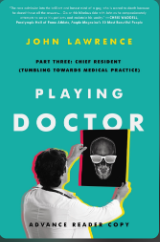
Playing Doctor Part Three by John Lawrence

Exhausted! That’s how I felt after reading this book. Chaos ruled in book one and when the hilarity continued in book two, I figured book three would be sedate and the shenanigans would be over. Boy, was I wrong! Book three was just as crazy, and I truly have no idea how he managed to fit so much into each day.

Book three tracks Doctor John in his third year of residency and we follow a conflicted year (After all this time in medicine he decided he might rather go into acting!) that should be easier as he has the theory and practise under his belt, but proves to be the opposite as he blanks in a code blue and continually questions himself about whether his decisions are correct.

Having done a few crazy long shifts in my time, I have the utmost respect for doctors and how they can continue to make such important decisions on a 33-hour shift. Especially in the ER with gunshot wounds, faces going through glass tables, kids accidentally getting hurt, and sutures that continually break. Even more so when dealing with patients that demand to be seen when their “emergency” is nowhere near serious.

What makes this book so relatable is how the author doesn’t gloss over the good, the bad, or the ugly. Infected abscesses, rashes, emergency births, kids with objects up their noses, and circumcisions are all on the table. We empathise with him as he deals with depressed or addicted patients. We cheer as he tries to get urology patients to admit that the main reason they came in was for Viagra. And we laugh as he regales us with stories of things that happened to him while not in the hospital. Here I’ll hint at manscaping, a rather nasty cut in the nether regions, a bag clip, and a blood spurt that made Vesuvius look weak.

A few punctuation gremlins crept in this time, but were not overly obvious enough to stop the flow of reading. The book is well written, and the style makes it personable, especially as he allows us into his relationships and we fall in and out of love with him. Thank you, Doctor John, for the ride!


Thanks to Reedsy Discovery and the author for the opportunity to review the book.

www.reedsy.com/discovery

Wednesday, 20 July 2022

Firestone: A Tale of the Eternal Stones Book One by Ryan Carriere


A Tale of the Eternal Stones: Firestone is the first in a fantasy series aimed at absolutely any age group that enjoys a good fantasy story.


Two stories run parallel to each other and are sure to meet up sometime within the series. On one side you have Sephonei, who has been forced into becoming a Crystal Hunter (with the barest of training), and who has set off with Ku-aya and Abil to find an eternal stone from a cavern just outside Atlantea.


On the other side, you have Roeg, who lives with the Great Spirit Clan but is an outsider as he was brought in as a child and looks different to everyone else. While battling to find his place within the clan, Roeg is given a quest by his adopted father and the shaman of the clan to go to the King of Gnomes, who will help him find the Land of Darkness. Along with his clanmates Tsisa and Ookum, Roeg will embark on a perilous journey to battle a fire demon and find the meaning of the firestone he carries.


However, the Crystal Hunters are after the same stone and their paths are on the verge of colliding…


First, I must apologise to the author for taking this long to write a review of the book. I only recently found it again after hardware crashed and burned and a promise is a promise! 


I enjoyed the book tremendously. I suspect the author has ties to South Africa as the terms “eish” and “kuk (kak)” were all too familiar! And I suspect the gnome bread had its roots in a rusk?


I liked how Sephonei was coming into her own, and no longer the scared child she started off as. Her quick thinking and abilities to understand her aura reading made her an excellent empath. Ku-aya was needed to ground the trio and Abil was just a nasty piece of work. However, I battled to understand their use of language sometimes with dialect words like fistler, and when I saw “yaa” my mind automatically said it was spelt incorrectly.


Roeg’s side spoke more to me as I felt transported along with his “growth” story and how he felt he didn’t belong anywhere, to showing his courage and being an integral part of saving the day. He showed that trying and trying again was what was needed and his empathy I think will somehow integrate with Sephonei’s. Tsisa’s bravery was fun but foolish, and I enjoyed Ookum’s perseverance in trying to find his place in the world.


I was intrigued by the mythical creatures, and Sephonei’s recordings of them in her journal, including the sketches. There were, however, a few grammar and punctuation errors that stopped me a couple of times within the script. Overall, a fantastic read and since the story ends in a place open for the next chapter, I look forward to reading the next one!


Thanks to the author for the opportunity to review the book (albeit eventually!).